
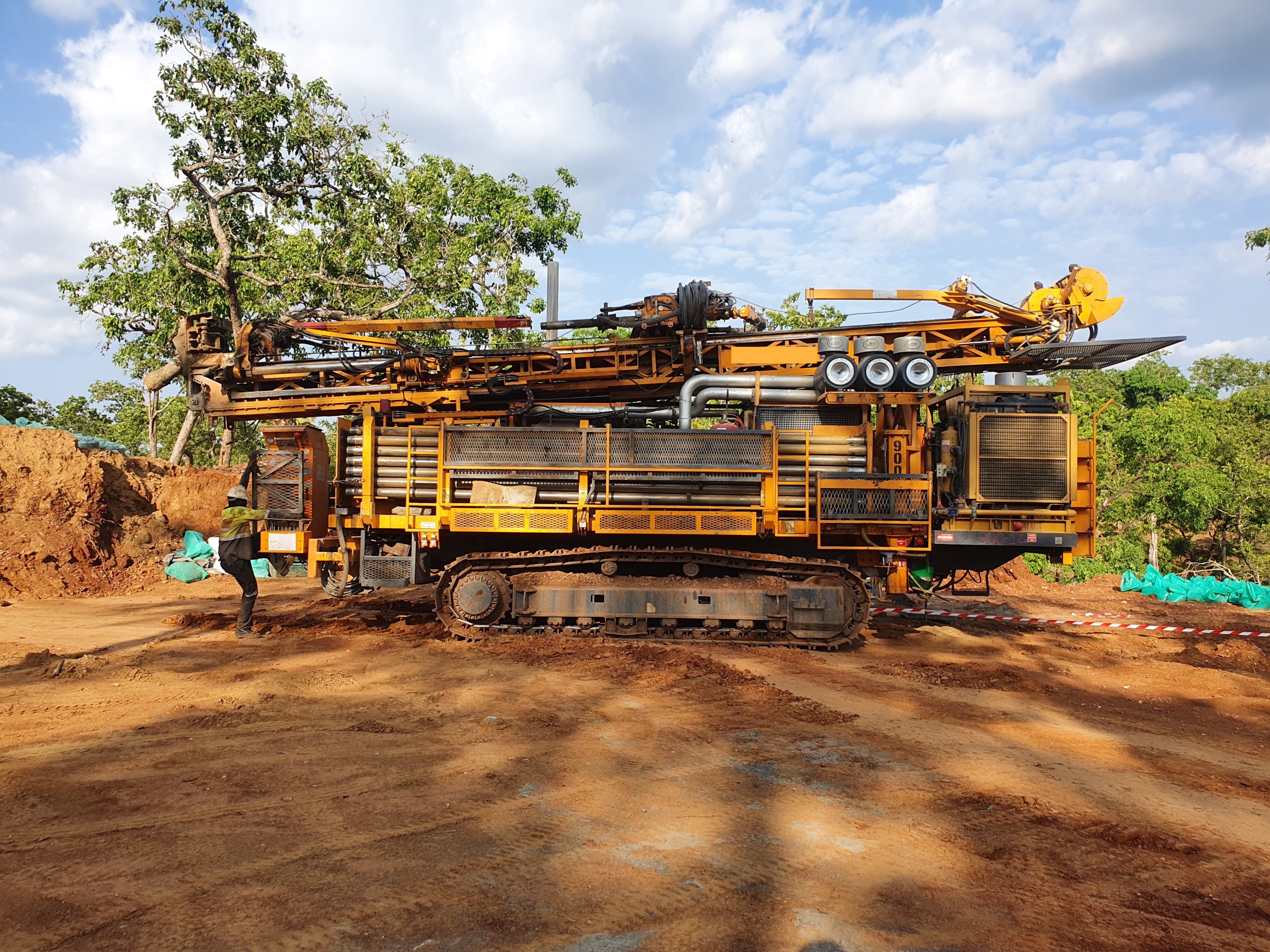
Before I worked in the field, I understood mining mostly as a technical process. I knew, in theory, that only a tiny amount of metal can be found in a much larger body of rock, or ore, to use the geological term. But in 2020, when I started working on a gold exploration project before later moving into finance, that knowledge became physical. Mining stopped being an abstract industry and became something I could see in the soil, the drilling machines, the samples, and the land around me.
That experience changed how I think about the value of metals. On average, as a broad approximation, about 2,000 tonnes of rock must be displaced and processed to produce one kilogram of gold. That is roughly 50 trucks filled with waste rock for a single kilogram of metal. When people look at a gold bar, they rarely picture the topsoil removed, the bedrock reached, or the material crushed, transported and processed. Technology makes this possible at scale, but it does not make the task small. Mining is built on heavy drilling machines, fuel, transport, labour and significant upfront capital expenditure.
This is why I find it difficult to talk about mining only in terms of market prices. Before extraction even begins, a company has to decide whether the project is economically feasible. Is the metal worth the effort, the manpower, the machinery and the fuel required to excavate, transport and process the material? And before that, there is an even more basic question: where should the company start looking?
What I saw before the mine
I have a BSc. in Geology, and my first job out of university was to be a “gold digger” — pun intended. Other geologists had already identified the area as potentially rich in gold. Desktop research, including the analysis of previous geological maps, had already been completed. In some places, especially in Africa, informal miners were already making money by mining small areas, which was another sign that something valuable might be present.
I joined the project when the company was relatively certain that there was something to be found. That was when the expensive drilling machines arrived. I was part of the team of geologists supervising those machines, and the company was billed according to the number of days they were used. Because owning this kind of equipment can be costly, mining companies often subcontract this work1. My role was to make sure the drilling was done accurately, to map the field and the rocks, to examine the recovered material, and to supervise sample collection for later geochemical assessment. It was technical work, but it was also a lesson in scale: before a mine exists, capital is already being spent, land is already being disturbed, and decisions are already being made about what that land might become.
My role was to make sure the drilling was done accurately, to map the field and the rocks, to examine the recovered material, and to supervise sample collection for later geochemical assessment.
Mineral extraction is an economic choice
Gold makes this tension easy to understand. Its demand is driven by jewellery, investment, technology, bars and coins, and central banks. Those uses support the mining activity required to bring gold from rock to its refined form. When I worked in the industry and saw the price of gold, I could not help thinking about the economics and financing behind the investment. The price of the metal is visible; the conditions that make extraction possible are much easier to ignore.
The same question now applies far beyond gold. Other minerals and metals have become central to global negotiations because of their role in the energy transition. Wind turbines, solar panels, electric vehicles, electricity grids, batteries and other technologies all require materials that must come from somewhere. That reality should make us more honest, not less, about extraction. If societies want more clean technologies, they also need to confront the mining behind them. Between 2022 and 2050, the energy transition is estimated to require 6.5 billion tonnes of end-use materials for technologies such as wind turbines, solar panels, electric vehicles and other systems2. Most of that demand is expected to be made up of steel, copper and aluminium, with smaller quantities of critical minerals such as lithium, cobalt, graphite and rare earths. Even when some critical minerals are smaller by weight, the challenge is still enormous because supply must grow quickly, responsibly and at scale3.
The price of the metal is visible; the conditions that make extraction possible are much easier to ignore.
Mining, people and ecosystems
Mining comes with major environmental and biodiversity challenges, but the social side is just as important. In the project I worked on, populations had to be displaced, and potential issues linked to mining-product leachates had to be addressed from the beginning to avoid further repercussions for people’s livelihoods. These are not side issues. They are part of the real cost of extraction. Digging into “virgin” ground, or into areas where people used to farm, rely on forests for their livelihoods, or live, is not neutral. The economics of such projects should therefore include a fair share of mining net profits for affected communities. What I saw on the ground was that discussions with local populations began from the start, especially to compensate people whose access to land would be directly affected by mining operations. Compensation was often monetary and supported by government assistance for relocation. But compensation does not make the disruption disappear.
What is often overlooked is the sheer size of mining operations and the way they affect nearby populations. For the project I worked on, imagine an operation roughly the size of Monaco, or about 280 football pitches, and as deep as the height of the Eiffel Tower. Some could argue that nothing can truly compensate for the loss of such a vast area of land, even when mining companies attempt to do so. I think that argument deserves to be taken seriously. The environmental risks continue during the life of a mine and after its closure. Leachates in the environment have become a major issue. In Côte d’Ivoire, for example, Lake Bia has reportedly been polluted after alleged gold mining operations, affecting fishermen’s access to ecosystem services provided by the water. Cyanide poisoning has also been reported near Ity, a gold mining operation. Studies near the Tongon mine in the north of the country have found metal concentrations in groundwater and surface water above World Health Organization recommendations. The following map I built shows some documented mining sites and reported incidents across Côte d'Ivoire. View the interactive map →
These examples show why the environmental consequences of mining cannot be treated as distant or theoretical. Despite these concerns, mining will continue, especially as demand for transition metals increases. The International Energy Agency has highlighted the need for substantial investment in critical minerals, while energy-transition estimates suggest that material demand through 2040 will be enormous - 750 billion in investment required4. This does not erase the environmental and social risks. It makes them harder to ignore. The question is no longer simply whether societies can secure the minerals they need. It is whether they can do so without treating land, biodiversity and local communities as acceptable losses.
The financing of mining activities
Mining companies generally obtain financing from banks, the stock market, private placements, or a mix of debt and equity. Through the stock market, investors can provide cash in exchange for ownership in a company and the possibility of a return. Companies can also raise money through debt obligations. Canada, the United Kingdom and Australia have been known as major stock-exchange centres for mining finance5. Private placements can also be used, where only a selected group of investors is approached to invest.
Government ownership of mining operations is often kept minimal, although there are exceptions. In countries such as China, for example, government involvement can be stronger, with a preference for majority ownership in some mining operations. Ownership matters because whoever finances or controls a project also influences the priorities around risk, return, environmental safeguards and community impact.
The financing method matters, too. A mining project can be funded either through corporate finance or project finance. In corporate finance, the financing sits directly on the company’s balance sheet. In project finance, the financing is structured around the project itself, often off balance sheet and with limited or no recourse to the parent company.
Corporate finance typically allows for lower transaction fees, while project finance commands higher fees because of the extensive work required to value the project on a stand-alone basis.
In project finance, financiers assess the discounted cash flow of the project: in other words, the future cash flows are evaluated in present terms to understand whether the project can support the financing. This is where the future of a landscape becomes a financial model. Financiers will also try to understand whether the project can generate enough cash flow to cover debt repayment. Ratios such as the loan life coverage ratio and the project life coverage ratio are used to assess that capacity. The debt service coverage ratio is also examined to check whether the project can meet its debt obligations over time. These ratios may sound technical, but they shape whether a mine is funded, delayed or abandoned. The required thresholds for these ratios depend on the market, the location of the mine and the risk profile of the project. The cost of capital is also assessed depending on whether the project relies on debt, equity, or both. Additional financial instruments may be associated with the financing, including derivative contracts used to hedge exposure to commodity-price fluctuations or currency movements. Whether and how to use these instruments can remain a matter of debate between shareholders and other equity investors6. But whatever the structure, finance is never separate from the mine itself. It helps determine how risk is priced, who benefits, and who may bear the consequences.
finance is never separate from the mine itself. It helps determine how risk is priced, who benefits, and who may bear the consequences.
My experience in gold exploration made mining tangible
As a former geologist now investment banking professional, gold prospection the value of a metal is not only reflected in its market price, but also in the land moved, the machinery deployed, the communities affected, the environmental risks created, and the financial structures required to make extraction possible. As demand for transition metals grows, I do not think the answer is to pretend that mining can be avoided. Nor do I think it is acceptable to speak about minerals only as inputs for growth, technology, or the energy transition. The honest position is harder: we need these materials, but we also need to confront the full cost of extracting them and decide, openly, how that cost should be shared.
Disclaimer This article reflects my personal views only. Nothing in it should be interpreted as representing the views, policies, positions, or opinions of my current employer, any previous employer, or any future employer with whom I may be associated.
References
Footnotes
-
Marsh, K. (2021). Mining trucks, loaders and haulage equipment for the mining industry. Mining Technology. Available at: https://www.mining-technology.com/buyers-guide/mining-loaders-trucks-haulage/ [Accessed 18 July 2026]. ↩
-
Energy Transitions Commission. (2023). It’s in the Charts — Materials needed to deliver the energy transition. Available at: https://www.energy-transitions.org/bitesize/its-in-the-charts-materials-needed-to-deliver-the-energy-transition/ [Accessed 17 July 2026]. ↩
-
International Energy Agency. (2026). Global Critical Minerals Outlook 2026. Available at: https://iea.blob.core.windows.net/assets/2831e0dc-f030-4d14-985c-d26d1af4430f/GlobalCriticalMineralsOutlook2026.pdf [Accessed 18 July 2026]. ↩
-
ibid. ↩
-
Crux Investor. (2025). The Decline of the London Stock Exchange in Mining Finance. Available at: https://www.cruxinvestor.com/posts/the-decline-of-the-london-stock-exchange-in-mining-finance [Accessed 17 July 2026]. ↩
-
LBMA. (2024). Financing Mining Projects — Alternative Methods. Alchemist, Issue 12. Available at: https://www.lbma.org.uk/alchemist/issue-12/financing-mining-projects-alternative-methods [Accessed 18 July 2026]. ↩